
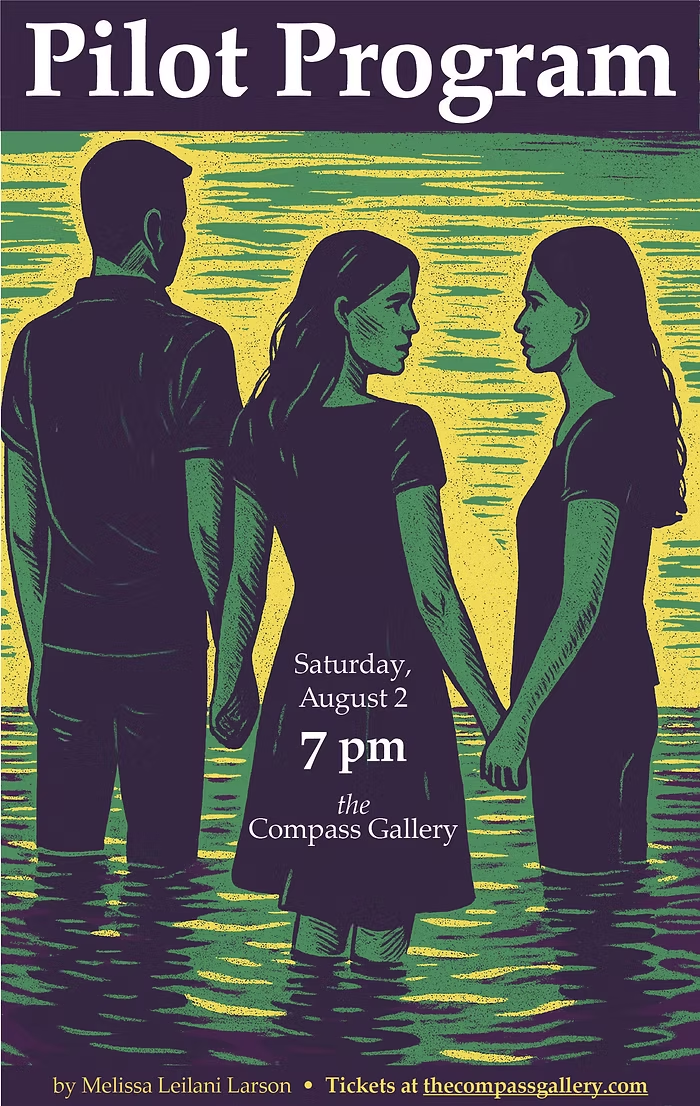

On August 2, 2025, at The Compass Gallery in Provo, I saw a staged reading of Melissa Leilani Larson’s play, Pilot Program. What little I knew about the premise intrigued me: what if you were asked to participate in an LDS church-sponsored experiment to live plural marriage in modern times? Fantastic hook, right?
For many LDS-adjacent folks—me included—the specter of polygamy raises huge feelings and a ton of Celestial baggage. During the Q&A after the reading, Melissa said that the genesis of her play was the question of what would be her deal breaker, the point where she could no longer consider herself a faithful Latter-day Saint? For her, that was being required to live in polygamy.
I was all in for the drama.
And, if I’m honest, a little disappointed at the lack of drama that was explored in the play.
Abby and Jacob are happily married and unhappily childless. Faithful LDS church goers, the play opens with a discussion about a request—a calling, if you will—they’ve received to be part of a pilot program to participate in a polygamist marriage. While initially reluctant, through a personal revelation of Abby’s, they decide to give it a shot. Abby reaches out to Heather, a former grad student of Abby’s and single woman in her early thirties, and the rest, as they say, is history.
Full disclosure: While this is Kate Baxter’s first public review of LDS media, it is not mine. I am a former professional theater critic, director, and playwright under different names. I usually review a play or movie or book within 24 hours of completing it. My reactions are fresher, memory sharper, and it’s simply easier. But no matter how many times I started this review, I had to stop and go back and think about it a little more. I realized I was stuck in the classic critic’s pitfall of trying to review the play I wanted to see instead of what I actually saw.
Pilot Program is really First Wife because Abby is the only character with a true arc. She’s the center that holds the entire piece.
In Pilot Program, after some initial qualms, the characters settle into figuring how to make their polygamous marriage work. Abby’s inner turmoil is expressed through blog posts that she delivers in monologue along with beautiful poetical musings about dripping kitchen faucets. She’s both angry and resigned, but too controlled as a character to fully expose or explore her feelings with God or anyone else.
For the audience, there’s a handwave to the idea of progeny being critical to a fulfilling mortal and Celestial life. It’s the possible linchpin for the appeal of polygamy for Abby and Jacob. Like Sarah and Hagar, choosing polygamy is Abby’s positive baby-moment and not the expected D&C 132 threat of eternal damnation for reluctant first wives. Maybe I’m jaded, but with adoption, IVF, and other options undiscussed, polygamy seems a big stretch if this is the real goal. As an audience we’re to assume this is God’s will and His ways are mysterious, and like the characters who are stalwart followers, we willingly go along with this premise. Based on the reaction at the reading, most do take the play at face value.
In Pilot Program, we don’t see Heather or Jacob’s journey. Jacob is the quintessential good guy. He shows concern for Abby and Heather, but has no real conflict with either. He’s so go-with-the-flow that it isn’t clear why he would choose Heather or even polygamy beyond Abby’s feeling that they should try it—and perhaps to have a child of his loins. He comes off as an affable labrador retriever, the very opposite of a kingdom-building patriarch. It’s subversive and interesting that their polygamy experiment is less patriarchy-driven than Abby-driven, but the play never explores these differences. It feels like a missed opportunity.
Heather’s motivation and character arc are underdeveloped. At the start, she’s happily single in San Francisco and progressing in her career. She had a close mentorship with Abby, but that’s water under the bridge. There doesn’t seem to be a payoff or motivation for her to join Abby and Jacob beyond a personal witness that it’s the right thing to do. This is intentional in the meta-framework of the play, but I can’t help but wish for more.
Throughout Pilot Program there are hints about Heather and Jacob’s romantic chemistry, mostly involving music and fast cars. It’s obvious that Heather’s more youthful and fun than Abby, but the lack of exploration about Heather and Jacob’s relationship weakens the the incident at the end. The betrayal—if it is a betrayal—doesn’t resonate as deeply as it could.
Discussions about house and marriage rules happen offstage and are only alluded to. I think it would have been thrilling to see the negotiations, the sparks that led to compromises, the feelings everyone had about complex issues, what they each needed to feel supported and heard in their three-way relationship, and why. Onstage discussions would’ve allowed the audience to anticipate the fallout when those agreements were compromised or broken.
I also had a hard time believing that three intelligent, self-aware people didn’t discuss ad nauseum about wedding nights, child rearing, PDA, and shared house space well before they became issues. It wasn’t believable that the characters were constantly surprised at things that I feel would’ve been at least nominally sorted before they happened.
Abby, Jacob, and Heather’s polygamy is no secret. They do a media interview, and there’s an allusion to awkwardness at church when they sit together on a pew, but the audience doesn’t know how the rest of the LDS faithful feel about this pilot program. Eventually a baby is born, presenting typical late night and childcare challenges, but by and large, the trio muddle through.
There are breathtaking at-last-she-said-it moments in the play—the audience around me gasped—but most of the potential conflict—the story—felt swept under the rug. Like the faithfulness of the characters in this being God’s will, the potential conflicts in the story lose their teeth when it’s more about enduring than living or true moral agency. No choice is not a choice—which most likely is the point of the play—but that’s ultimately unsatisfying in a play where conflict and accountability are so readily available to dive into.
Drama, right?
Good stories linger long after they’re consumed. Pilot Program certainly does that. Since the play, I’ve spent a lot of time wondering how a polygamy pilot program might actually work—while completely acknowledging that God does not need pilot programs; humans do. In the play we don’t hear of others who accepted or rejected this new polygamist calling; there’s no return and report except in my head where I see a group of grey-haired men getting told a cold statistic.
Brother Green: Of the 300 couples called, 210 said no, 90 said yes. 72 children were born. After five years, 13 families continue in polygamy. 77 first wives divorced, and 4 third wives were added. Reliance on church welfare for this group has gone up 740%.
Brother Blue: 740%? That’s unsustainable. That’s it then. It’s failed. Time to end the pilot program.
But that, like a lot of my critique here, is an entirely different play.
_____________
You can read Pilot Program in its published form in a two-play collection called Third Wheel: Particular Stories of Mormon Women in Love by Melissa Leilani Larson.
Amazon link: https://www.amazon.com/Third-Wheel-Peculiar-Stories-Mormon/dp/0998605239/
To learn more about what others have said about Pilot Program or to connect with Melissa Leilani Larson, click: https://www.melissaleilanilarson.com/pilot-program
Share with your Friends: